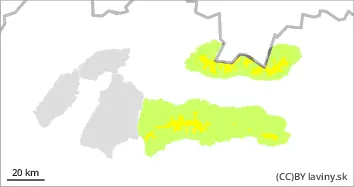
Moderate avalanche danger, level 2, is concentrated above the forest boundary where 15cm of new snow has fallen, which is getting heavier due to warming. Above 1700m above sea level, due to strong winds, unstable snow slabs and pillows are forming, especially in the northern orientations. The slabs and the new snow are deposited on the old hard base, which is not sufficiently well bonded with it. The avalanche can be released locally even with a small additional load. Smaller spontaneous avalanches may also occur due to warming.
Snowpack
The older snow cover is mostly well consolidated and settled. Up to 15cm of new snow has fallen on it. It is unevenly distributed, especially in the northern sector. Hard slabs alternate with puffy pillows of new snow. Isotherm zero is around 1700m above sea level. Below this threshold the snow is wet and heavy.
Tendency
During snowfall rising
Danger level
Avalanche Problem
Wet snow
New snow
Avalanche release is possible only sporadically.
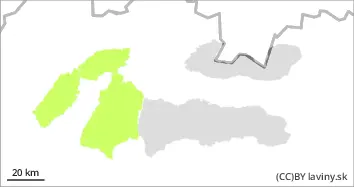
In the Fatra Mountains is declared 1st degree, low avalanche danger. Up to 10 cm of new snow has fallen above the forest border, which lies on hard ground with which it is not sufficiently well bonded. Avalanches can only be released sporadically on steep and very steep slopes of mostly small size.
Snowpack
The snow surface is mostly hard and load-bearing with up to 10cm of new snow from the last snowfall. This is settling and becoming heavier due to rain and warming. Isotherm zero is around 1500m above sea level.