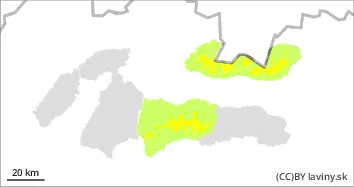
A MODERATE avalanche danger (Level 2) persists at the highest elevations
The main problem is fresh snow at the highest elevations. Be cautious of very steep areas, narrow gullies, slopes beneath rock faces, and terrain depressions where snow has been blown by the wind into snow pillows, slabs, and drifts. Prolonged low temperatures and a thin snowpack are leading to the development of critical—permanently weak—layers within the snowpack. Avalanches may be triggered primarily by significant additional loading, though the occurrence of smaller spontaneous avalanches from fresh snow cannot be ruled out.
Snowpack
During the most recent snowfall (Thursday–Friday), 10–15 cm of fresh snow fell. A continuous snow cover extends from the foothills, with significant depth found above the tree line, where it reaches 30 to 70 cm, and locally even more. Due to previous wind conditions, the snowpack is distributed very unevenly. The snow layers from individual snowfall periods are not sufficiently bonded to one another; inside, there are weak layers of angular-grained snow.
Tendency
Persistent
fk
Danger level
treeline
Avalanche Problem
New snow
Treeline
Watch out for fresh snow above the tree line.
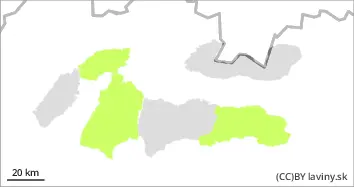
In the Fatra Mountains and the eastern part of the Low Tatras, there is a LOW avalanche danger (Level 1) above the tree line. The problem is fresh snow that has fallen in areas with an older snowpack. Under additional weight, small avalanches may be triggered on steep slopes.
Snowpack
During the most recent snowfall (Thursday–Friday), 10–15 cm of fresh snow fell, which in some places settled on layers of older, wind-blown snow. Within the snowpack, there are weak layers of angular-grained snow. Overall, there is 15 to 40 cm of snow in the mountains, distributed unevenly due to wind.