New, mostly wind-blown snow on a critical layer of hail.
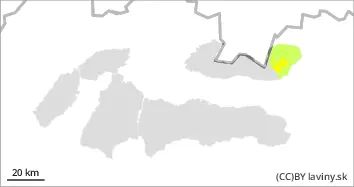
MODERATE (2nd degree) avalanche danger will be concentrated in the eastern part of the High Tatras mainly above 1600m above sea level. Due to snowfall and wind, snow slabs and pillows of different thickness and hardness will form mainly on the leeward slopes of the NW, S and E orientations. Underneath them there will be a layer of hail from the last light snowfall, which will form a critical hazard layer. They are located in the snow profile above 1800m above sea level. It will be possible to release the avalanche especially with a large additional load.
Snowpack
The snow cover is firn on the southern slopes, hard after the current cold snap. In the northern sectors mostly stable but not worn. Up to 10cm of new snow has fallen in the last snowfall period. Due to north to north-westerly winds up to 15m/s, it will be deposited very unevenly on leeward places. On hard ground, the snow slabs and pillows thus formed will be unbound, susceptible to avalanche release. At the highest elevations, watch out for a layer of hail in the profile.
Tendency
Under the influence of sunlight rising.
Danger level
Avalanche Problem
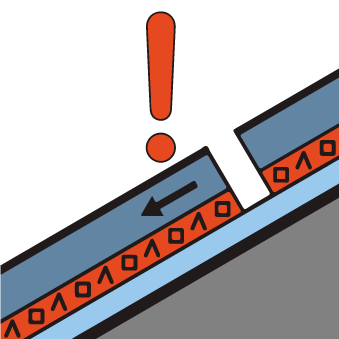
Wind slab
Locally rolled snow slabs and cushions on hard ground.
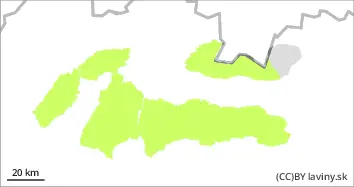
LOW (1st degree) avalanche danger applies to most of the mountain area of Slovakia. On hard firn base there will be locally snow slabs and pillows not connected to the base. Small avalanches may be released mainly on steep slopes, mainly under high additional loads.
Snowpack
Due to the arrival of the cold front, the old firn snow is hard wearing on the southern orientations. In the northern sector it is locally breaking into softer layers. Up to 5 cm of snow has fallen in the last period, accompanied by fresh winds. Locally, snow slabs and pillows have formed on the hard ground, which are not sufficiently bonded to the subsoil.