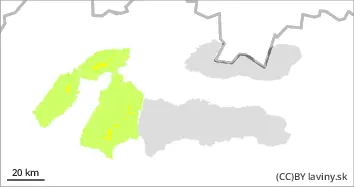
Watch out for wind-blown snow that has created unstable snow slabs and pillows.
Due to snowfall and strong winds, there is a moderate avalanche danger in the Fatra Mountains above the forest zone, 2nd degree. The avalanche danger is local, concentrated in places where the wind blows a larger amount of new snow. This is in the form of unstable snow slabs and pillows in couloirs, moguls and under saddles. Avalanche release on such steep slopes, where old frozen snow is still under the new snow, is possible, especially with additional loads. Larger spontaneous avalanches are not expected.
Snowpack
The snow cover is varied. 20 to 35 cm of new snow has fallen in the last 3 days. This has been transported by strong NW to W winds to leeward places and into the forest zone, where its height reaches even more than 50 cm. In places exposed to the wind, the surface of the snow is blown down to the old snow, possibly rocks and grass. Due to the very low temperatures, the new snow cannot bind with the old snow base and remains unstable. The old frozen snow is only found from about 1400 m above sea level (depending on orientation). The total snow depth remains below average, ranging from 20 to 50 cm.
fk
Tendency
persistent
Danger level
treeline
Avalanche Problem
Wind slab
Treeline
Persistent weak layer
Treeline
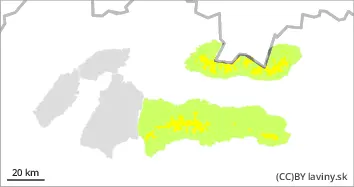
Watch out for wind-drifted snow that has created unstable snow slabs and pillows.
Due to snowfall and strong wind there is a MODERATE avalanche danger in the Tatras and Low Tatras, in positions above the forest zone, 2nd degree. The avalanche danger is local, concentrated in places where the wind has accumulated a larger amount of new snow. Such locations are relatively easy to spot in the terrain. The new snow is deposited in the form of unstable snow slabs and pillows in gullies, moguls and under rock walls. Avalanche release on such steep slopes, where old frozen snow is still under the new snow, is possible, especially with additional loading. Larger spontaneous avalanches are not expected.
Snowpack
The snow cover is varied. During the last snowfall period (5 days with breaks) 25 to 40 cm of new snow fell. However, due to strong winds, it has been transported to leeward places and into the forest zone, where its height reaches more than 60 cm. In places exposed to the wind, the surface of the snow is blown down to the old snow or rocks and grass. Due to the very low temperatures, the new snow cannot bind with the old snow base and remains unstable. Underneath the new snow and the old hard crust there is a distinct layer of square-grained snow. This can be an avalanche problem at higher additional loads. Old frozen snow is found from about 1400-1700 m above sea level (depending on orientation and mountain range). The total snow depth remains below average, ranging from 25 to 75 cm.
fk