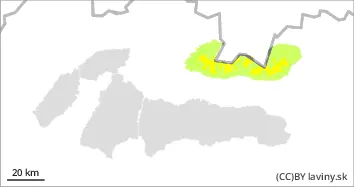
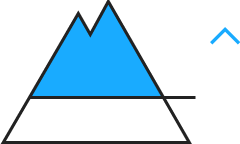
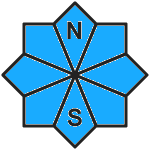
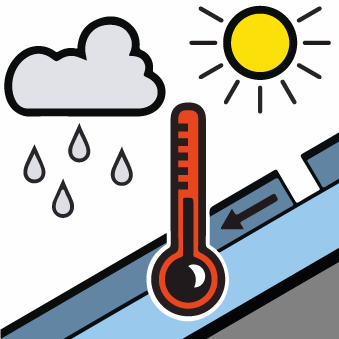
On steep slopes, small to medium-sized avalanches from wet snow are possible, especially under mechanical loading. Occasional spontaneous avalanches may also occur, especially in places where large amounts of snow have accumulated from previous snowfalls. At the highest altitudes, especially on the northern slopes, dry, wind-drifted snow still persists, which may not be well bonded to the subsoil. Here, slab avalanches are possible, especially under high additional loads.
Snowpack
The snow surface is very varied due to the changeable weather in recent days. At mid-elevations the snow is moist to wet, higher up, and especially on the northern slopes, it is crusted, and at the highest elevations the snow on the northern exposures is still dry, winding up in the form of snow slabs and pillows. In the next few days we expect a strong warming, when the air temperature at 1500 m above sea level will rise up to +7, +8°C.
Tendency
generally persistent
Danger level
1700m
Avalanche Problem
Wet snow
1700m
Beware of avalanches from wet snow.
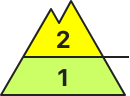
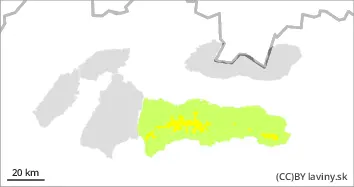
Moderate avalanche danger in the Low Tatras persists at higher altitudes, 2nd degree. Due to warming, the main problem is wet snow, basically in all altitude zones. Avalanche release is possible on steep slopes, especially with high additional loads. Occasionally, smaller spontaneous avalanches from wet snow may also occur.
Snowpack
Due to the strong warming, the snow cover is wet, in the middle altitudes throughout the profile. At the highest altitudes, crust from the previous cold snap is locally present on the surface. The Low Tatras have the highest snow cover compared to the other mountain ranges, with snow depths ranging from 20 to 90 cm.
Tendency
persistent state
Danger level
treeline
Avalanche Problem
Wet snow
Treeline
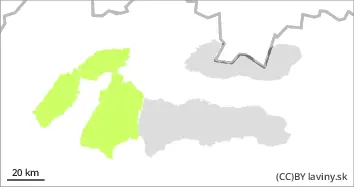
In the Fatra Mountains, small avalanches from wet snow are possible
especially under high additional loads. Avalanche danger is only local, linked to steep slopes and moguls.
Snowpack
The snow cover is mostly wet due to the warming, often in the whole profile. The more continuous layer is mainly in the gullies and moguls and reaches a maximum of 50 cm.